
Recap: The Quran shows direction. In the second principle, the author has been comparing an attitude one may develop as a result of following wisdom from the Quran or from Philosophy. The sincere student of Philosophy is a “pharaoh”.
- The sincere student of Quranic wisdom is a “servant”: abd or worshiper of God
- This person acknowledges that everything is created by the One who creates the universe. He sees meaning being transferred in the act of creation and is aware that every object/event in this universe carries a meaning.
- He receives the message from the objects that the Creator wants to transfer.
- His relationship with the object is for the purpose of getting to know His Lord: that is worship.
- Some may see a contradiction with this type of attitude i.e. we have nothing to hold on to. Everything belongs to the Creator of the universe and we cannot claim ownership over anything. As a result of not feeling dignified, these individuals may turn themselves into miserable individuals as follows:
- They do not bother improving their human qualities because they feel that there is nothing to be gained at the end.
- They think that they are being modest individuals by becoming the slaves of their Creator with no human dignity.
- According to the Quranic wisdom, we are powerless and everything belongs to Him.
- The main teaching of the Quran is that everything is “created” and is totally dependent on its “Creator”.
- We should not be thanking or admiring the object as if it is the source of giving us the pleasure.
- The Quran establishes a worldview as follows:
-
-
- We cannot exist on our own; we are totally dependent on the Creator.
- The objects are employed by the Creator to display His qualities.
- Example: the sun is not the source of providing us light; it is following the order set by the Creator of the universe and is employed to rise and to set at specific times.
-
-
- Some people may claim to have some sort of power of authority and thus impose it on others and misuse their gains in the world as if they are the real owners of the things. As a result, we may attach ourselves to their qualities and power and thus fall into the trap of admiring them.
- That’s why we have to follow the Quranic wisdom :
- Any being cannot be the Creator or the source of its qualities.
- The qualities that the being acquired is given to it by the will of the Creator.
- Together with their existence, all the qualities of the being are dependent on the will/power of its Creator.
- The being is just using those qualities.
- Nothing belongs to us including our given human faculties.
- Example: We may think that our memory belongs to us. But when we do not remember something, it is a sign that: “I do not own anything.”
- The scripture teaches us wisdom so that we may liberate ourselves from false perceptions.
- Question: If you want to be saved, what can be your savior?
- Answer: The savior is my attitude, my awareness, my consciousness: Anything (the object and its qualities) that exists in this world can only be in existence by the Will of the Creator of the universe.
- An object cannot exist by itself. What makes an object is its existence together with its qualities.
- The object and its qualities cannot be separated. Example: I may have been given some quality. When I use it, I am simply “asking” the Creator to further develop it for me. Similarly, we may admire a dancer as being talented. Dancer and their qualities are all created together.
- In its totality, every being is dependent on its Creator.
- Nothing in the universe can be the cause of existence of any of its qualities.
- We are given the ability to be conscious of our needs and given qualities and we thus ask the Creator to improve it for us. Although we use our freewill when we want something to be created by Him, ultimately He is the One producing the result. For example: I want to improve my swimming skills and I take the classes. While exercising my freewill, I am asking Him to improve my skills.
- Therefore, everything is equal before its Creator. That is liberation: we can save ourselves from being enslaved by any creatures because we belong to the Creator. Establishing this fundamental belief is the source of our freedom.
- By understanding the belief in the Oneness of God and the Absoluteness of God, we may be liberated. This belief is our savior.
- No one can save you. As far as His established Order in the universe is concerned, we cannot expect the Creator to save us arbitrarily either.
- I can understand the reality of existence and save myself by obeying this reality. It is within the order of the rules of creation that He has established. That is part of His will.
- Whoever looks at the meaning of his life and releases himself from the slavery of worshiping the object themselves, he is saved.
- Everything is established by Him and I have to accept the rules that I find in the order of creation.
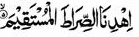
- Verse: “Guide us to the straight path”. Sura Fatiha 1:(5)
- Prayer: “Please God guide us to the right path” means asking Him to save you from being enslaved to anything besides His Divinity.
- Anything in the scripture is a guide for us; a guide to our situation, our reality and Who to ask for help.
- God teaches me that I have to ask Him to be guided.
- If you want to be guided, “guidance” can be provided by the Creator: the Lord of the Worlds.
- The Lord of the universe is treating you in His way as you ask to be guided. My attitude towards Him matters: the more I feel comfortable about my relationship with Him, the more I will realize that it is He Who is helping me.
- I want to be rightly guided to understand the Creator.
- The verse implies that we have to pay attention to the fact that whenever we want to be guided, we are obeying His created order. But ultimately, by obeying His order we are asking the Creator to give us something because everything is created by Him.
- We get as much as we have developed our awareness of the Creator.
- If you want to be saved, your savior is within your own attitude: how much of your reality are you aware of?
- The saving process can only start within your own consciousness of your reality. My reality is my innate qualities and my awareness of who I am as a created being i.e. I am needy…
- We are created in such a wonderful way that we can act within the order of the universe and be absolutely conscious of our Creator.
- We ask and when we get something, we have to be aware that the guidance is only from Him: we do not create anything/no one creates anything for us; we just exercise our freewill in His name by His Mercy.
- When we read any verse, we have to bear in mind that the message came to us through the Prophet (pbuh).
- The Prophet (pbuh) exemplified the ideas of Quranic teachings in the form of a human being.
- Analogy: The tree bears fruits. Is the meaning of the fruit separate from the tree? No.
- Similarly, our understanding of Prophethood is in tuned with our belief in the message he brings to us. We cannot believe in the message bearer independently from the message he brings, as we cannot imagine the existence of the fruit independently from the existence of its tree.
- If someone does not understand the Absoluteness of God, he is bound to make mistakes in his understanding: we have to be absolutely aware that every single thing in this universe needs to be explained in terms of directly being connected to the Creator of the whole universe.
- As a result of our investigation of the universe we understand that everything comes into existence by the will of the Creator of “the whole universe”, not by the thing itself. This means that there can only be One Creator, Who must be Absolute. Sometimes I am uncertain about His Absoluteness, how do I get out of this? We need to develop our understanding of the existence of a single being in the universe: Can it come into existence without being given existence by the Creator of the whole universe? We have to investigate it. The Creator of the whole universe cannot be of the same nature of what He has created. Absoluteness of the Creator means He cannot be perceived or imagined with any qualities of this universe. He must be the Creator of these qualities.
- How can we make sure that the message exemplified by any Prophet is right?
- We have to go back to creation and observe the universe. Based on our conclusion, we have to confirm that the message of the scripture presented by a person seems right.
- Any scripture must be the speech of the Lord of the universe.
- Without establishing any ties with the Creator, we cannot understand what Lord of the universe means.
- In order to avoid “claiming” our confirmation, we need to establish criteria within ourselves: I am learning something from the Prophet (pbuh) but what I learn from the Prophet is nothing but the message of the Creator of the universe. We have to analyze our conclusion under the witnessing of the universe.
- Analogy: When we get eggs, we do not worship the hen because we know that the hen is created, the eggs are created.
- Similarly, we should not attribute any deity qualities to any objects because it is benefitting us.
- Every single event that we experience is the act of creation of the Owner.
- When we look at the exemplary life of anyone we admire, we should not start worshipping that person. Similarly, the Prophets do not possess any super powers; they are just employed to exemplify the message as human beings for us.
- Prophets are not the source of knowledge they transfer to us but they are the envoy of the knowledge.
- We should not worship them as if they were the creators of their qualities but learn the message from them.
- Analogy: A tree gives fruits. You cut the tree because you say that the tree is not the cause of the fruits.
- Similarly, we cannot disconnect ourselves from the envoy: The Prophet (pbuh) is employed by God to convey to me the message of the Creator.
- The Prophet is not the source of existence of the “exemplary teachings” as well.
- “Blind imitation” is not part of His created order of the universe. The creation of the option for human beings to choose “Blind imitation” is good because only through rejecting this option that we appreciate “conscious confirmation.” My choice of “blind imitation” is not confirmed by any part of the order of the universe; there is no sign in the universe where I can justify “blind imitation.” Nevertheless, when I choose “blind imitation” it is created for me and I have to bear the consequence of it.
- Every judgment or conclusion is subjective to you personally.
- Religion is your own personal conclusion.
- How can I make sure that my own personal conclusion is absolutely true?
- No one can. When we read the scripture, we establish our own worldview by confirming it through the witnessing of the universe.
- How can a person convey his personal conclusion to someone?
- Your responsibility is to educate yourself and share the message in the best way. (maw’ida hasana, kaulan layyinan) Try to convey it with a language in the sweetest way and with wisdom (hikmah.).
- If someone accepts or rejects the conveyed message is not your concern.
- You just work on widening your spectrum of learning and teaching: get into unveiling different layers of meaning.
- Two apparent contradictory attitudes must be seriously taken into account when we study the scripture:
- The speech of God says: I am clear.
- The speech of God also says: you have to interpret.
- In reality, the scripture is clear and you have to understand it according to your own definition of the scripture.
- Accordingly, you will interpret the clear text “from your perception”.
- In and of itself, the text is clear but my understanding of it may not be clear because of the filter of my perception. I have to try to clean it, by learning more and more. It never ends.
- Therefore, I will decipher the meaning as much as I train myself.
- Kitab un mubeen: it is a clear text but at the same time you have to interpret it.
- You can interpret the text according to your own understanding which is subjective to you only.
- Speech of God does not tell you what you can acquire with the ability you have been already endowed with to know.
- Speech of God tells you what you do not know and what you should learn.
- Just as a math book gives you the formula to solve a problem. Similarly, the scripture gives you guidance to interpret your life.
- The scripture says: “I am here to teach you who your Lord is”.
- Example: Scripture says: “Do not steal”.
- Potentially, we are all endowed with the ability of “not to steal”.
- We have to acknowledge the real source giver of this ability.
- Wrong attitude: I will not steal because I want to be a good man.
- Has the purpose of my acknowledging the Creator been accomplished? No.
- Correct attitude: I will not steal because my Creator of this sense has instructed me not to steal: “I will not steal in the name of my Creator”.
- Any attitude that does not acknowledge the Creator implies that we own this sense.
- The sincere student of the Quran does not aim at gaining Paradise.
- He follows the reality and does not have any expectations in return of his actions.
- Wrong attitude: I will not steal because I will get Paradise.
- Correct attitude: I will not steal because it is my reality.
- This reality belongs to my Creator and so I should have no expectations in return of my actions.
- My worship is nothing more than confirming my reality.
- The student of the Quran is so honorable that he does everything for the sake of the truth.
- Truth: I am created with this ability and I should not abuse it. I have to be honest to it. I should be consistent with the way that I am created and not distort it. Truth is engrained in my reality. I have to discover it and confirm it. My reality is the truth.
- Action is an independent entity from belief though they are linked to each other. Action stems from belief. Each action is the confirmation of the elements (hereafter, angels, scriptures, messenger…) of belief. When I do the action, there is a realization of the belief in me. For example: Let’s take the element hereafter. I get sad when a joyful event is over, so I take action i.e. I utilize my freewill to train myself not to attach myself to the event itself but to an eternal life and thus conclude the hereafter. Based on how much I have trained myself, I will gradually be able to plug in more elements in my realization of belief.
- Sometimes, it may seem that action comes first and then belief. For example: I “decide” to give charity to someone out of sympathy. “Decision” in itself is an action. Here, I should know my reality: that the sense of sympathy is given to me by my Creator. That is the way to come to know the truth of belief in the Creator. At the end of this realization I start giving charity in His name by acknowledging His ownership, here action served as a vehicle to help me realize the truth of belief.
- The student following the Quranic wisdom is humble and yet cannot adore anything other than His Creator.
- He appreciates everything in The Creator’s name.
- No one can make this individual worship themselves.
- Regardless of being the richest or poorest man, he sees everything as given to him by his Creator.
- In his relationship with creation, he is modest.
- Modest: I cannot worship or adore anyone other than the Creator of the universe and I would not like anyone else to adore or worship me either.