
Session 60 Notes
The Qur’an must be regarded as the Revelation from the Creator of the universe speaking to human beings right now. It tells us what we don’t know, what we cannot learn from the universe by using our human potential. We must be careful with the Qur’an and not take the message as simply something that is obvious, something that can be learnt by a human being. For example, the sense of justice is given to everyone where they all seek justice. The Qur’an mentions justice as well but within the context of the purpose of the Qur’an. We seek justice among human beings in our social life. However, the Qur’an addresses the already existing sense of justice in human beings and extends that justice to the whole universe, far beyond our social life. Thus the Qur’an teaches what human beings cannot know by themselves and describes the universe as created with justice witnessing its Creator. If someone says the universe just happens to exist by itself, they are treating the universe unjustly, in fact insulting the universe.
Approaching the Qur’an does not require an initial act of blind faith, nor does it ask the reader to start by unconditionally submitting to its divine origin. Rather, it asks for a fair and logical trial. To judge any text fairly, one must first test it against its own claimed identity—in this case, as a Speech from the Creator of the universe, who possesses infinite knowledge, wisdom, and power.
Only by reading it through this initial lens can a reader genuinely evaluate whether its content, scope, and depth match such a high claim. If, after such a reading, the text fails to reflect the signature of the Creator of the cosmos and human beings in it, the reader is entirely free to reject it as a human fabrication. However, evaluating a text under the wrong assumption guarantees a misunderstanding.
Consider an advanced Calculus textbook filled with complex equations and mathematical symbols: if someone approaches it assuming it was scribbled by a five-year-old child, they will inevitably dismiss it as meaningless noise and laugh at it. The failure in that scenario lies not in the textbook, but in the reader’s flawed starting assumption. Likewise, to read a book claiming to be Divine Speech through the lens of ordinary human authorship is to misread its purpose from the very first page.
Thus, the Qur’an must be read on its own terms as a divine speech, coming from Absolute Knowledge. We cannot put the Qur’an at a particular time and place, relating it to the local practices of the bedouin people living in the desert conditions.
How Divine Speech must be Read
Below is a list of some fundamental principles of the Qur’an for a deeper and personal understanding:
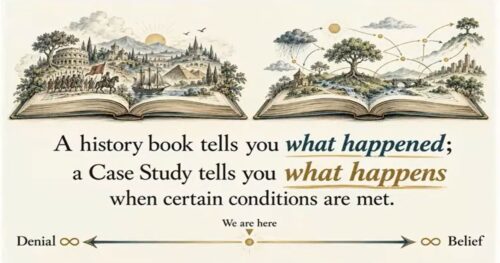
- Absolute Clarity: The Quran speaks in black-and-white terms without gray areas, providing a clear path of guidance. The gray area is subject to human practices but the Qur’an speaks in black and white terms to allow the individual to grasp the message clearly knowing what is absolutely right and what is absolutely wrong. There is a lot of mention about belief, “imaan”, in the Absolute Being with many clear examples to distinguish between perfect belief and perfect unbelief. We human beings always find ourselves in between and thus have to exercise our free will to make the right choices towards either belief or unbelief. No one can claim that they have attained perfect belief or perfect unbelief but always finds themselves in between them. We can visualize this to a point in a straight line where one direction leads to positive infinity and the other to negative infinity. What is important for us is which direction we are following. We cannot know how far from the last point because it is infinite. Only God knows who is where. That is why we should not be and we cannot be judgmental about the belief or sincerity of other people. We need to take care of ourselves.
- Prophetic Accounts: More than half of the Qur’an is devoted to the prophetic narratives. They are seemingly read as a history or story book which is clarified in the third point.
- Authentic Human Experiences: These are not scenarios but represent fundamental problems of human life, serving as case studies where everyone must try to find themselves in that situation. Each prophet, each narration represents one fundamental problem of human social or personal life. We must bear in mind that these narrations are meant to establish our relationship with our Creator in any circumstance. For example, sometimes, we may find ourselves in the position of prophet Solomon. Another time, we may be in the situation of Moses who covers many different aspects of human life. In a family situation, a wife may object to the husband or vice versa, we know that prophet Lot’s wife rejected his message, Pharoah’s wife rejected her husband’s message. Some prophets had believing children and some who rejected their message and became unbelieving children. Prophet Abraham is an example of someone whose father was an enemy of him. Prophet Noah is the example for those whose children reject their father’s message. Prophet Joseph is the example whose siblings are his enemies. Prophet Jacob is the example for those some of whose children are following his messages and some not. We may find ourselves in such scenarios and thus find guidance from the prophetic behavior.
- Application over history: The Qur’an is not a history book. The goal is not to prove the historical facts but to apply these examples in one’s own life. The purpose is not to believe whether Moses really existed in a specific time and space. The narrations of Moses and Abraham are simply examples to be applied in our living conditions by following the prophetic pattern. For example, your parents reject what you are doing in terms of your religion and the hereafter. You can take the example of Abraham in his relationship with his father. The historical details of where Abraham lived, who was his father, what time, what region etc. should not be our concern. Our business must be to apply his example in our time and living conditions right now.
- Miracles as evidence of the prophet being employed by God: Miracles are not for human imitation but to demonstrate that despite witnessing miracles, some of hostile contemporaries still rejected divine truths. Today, the Qur’an itself and the ordered cosmos are our primary miracles. We must thus demonstrate the miraculous message of the Qur’an and the miraculous creation in the universe to counter unbelief.
The contemporaries of the prophets needed to witness the miracles to take them seriously. Otherwise, how could they trust the prophets as being employed by the Creator of the universe. It is human to be suspicious if someone claims to be bringing the message from the Creator of the universe. How can one make sure to believe in this person? Even if someone comes to us now claiming that there is One God, we would wonder who this person is who says that God spoke to him. There must be some evidence for the one who claims that they are employed by God, the Creator of the universe.
Thus, the prophets were given special miracles which are called prophetic miracles where extraordinary events need to be created so that their contemporary people feel comfortable about their claim. No one can change the order of the creation in the universe except the Creator of the universe. Evaluate the prophetic message. The person claiming to be a prophet of God is not a sage or knowledgeable or a fabricator with his own ideas and then one can decide to accept it or not. However, take this person seriously after witnessing the miracle. - Universal validity: While living conditions change, human essence (fitra) and spirit never do, making the message always valid.
Someone may say that they are not living in a desert. That is fine but you may be a human being who is living in a big city. It doesn’t matter where one lives as the universe is continuously changing, demonstrating their miraculous creation to us, disclosing the reality of its Creator. Although the prophet Muhammad (pbuh) lived in a particular time and geographical place, the message he brings is not historical but universal, beyond the history and beyond time and space.
The human spirit, human capacity are also universal. It doesn’t matter what discipline one studies, everyone has the capacity to benefit from the message of the Qur’an and become a worshiper of God by applying the universal principles in the Qur’an. - Core Messages: It covers the fundamental articles of belief, such as the Uniqueness of the Creator, Prophethood, Resurrection, Worshiping God, and Justice.
- Prophetic chain (Adam to Muhammad (pbuh) ): Every person can find themselves in the story of Adam, representing full human potential. When the verse of the Qur’an says that Adam has been taught all the names, it means we are all created with this complete human potential. The angels prostrating to Adam means that everything in creation is serving us. The whole universe has an angelic side that serves human beings. We must observe the universe by paying attention to its angelic side that tells us who the Owner of the universe is and what qualities He has. Everyone can find themselves in the story of Adam, where they can be misled by Satan in the wrong direction.
If we consider Adam to be the seed of the tree of the prophetic mission, then all the prophets are the branches of this tree. Each of them, within their own time and place, serves as a fruit of this tree of the prophetic mission. Prophet Muhammad, meanwhile, is the final and most mature fruit of this tree, embodying the fundamental messages of all the previous prophets in a perfected form.
- Concise Message: The Qur’an contains the essence of all previous revelations, serving as a comprehensive summary. The Prophet Muhammad (pbuh) represents the fruit of the human tree.
- Directional Guidance: The Qur’an shows us the right direction to take regardless of where we are in our journey. We are in need of this precious blessing of the Qur’an. What is our biggest blessing? Our kids or the Qur’an? Once one follows the Qur’anic message, their children become a blessing for them.
- Present tense understanding: The Qur’an must be read as if everything is happening right now in the present, not as an event from the past. Read the story of Joseph as my own story where I can say that I am Joseph. In our lives, we go through ups and downs, we can relate this to the time prophet Joseph spent when thrown into the well. At another event, the immigrant and foreigner gained an important position. Every event becomes our life story.
Let’s examine Figure 1 describing the difference between taking the Qur’an as a history book which only gives us the news of the past and the other being a case study which we can relate to our own life right now. The Qur’an describes belief and unbelief which have infinite layers, the same is true for Paradise and Hell which are the results of belief and unbelief. Everyone will have a place there but the important thing is to be on the way to Paradise if we want eternal pleasure. The Qur’an and prophetic narrations mention about the intention of a human being which determines their result. If one decides to be a worshiper of God then they can be on that journey by doing their best effort as much as they can. God gives us the good news that everyone will be treated according to their intention, according to what their level of belief is. (28:84, 6:160, 10:26-27)
Figure 1
In conclusion, when we open the Mushaf, we are going to see that: “My Creator is speaking to me right now”. This “right now” is the secret of benefitting from the message of the Qur’an.