
Session 38 Notes
We have been studying the materialistic interpretation of the universe whether it makes any sense by examining the reality of the universe which contradicts that interpretation. We examined the language used to interpret any being in the universe and see that the materialists don’t explain the existence of anything and try to avoid any such questions that result in concluding a transcendent being. They use contradictory, sometimes tricky language but with well-voiced presentation, including empirical supporting data that influences many people. They describe the relational and compositional structure as observed. The materialist interpretation has become the mainstream ideas propagated by authoritative, well spoken scientists. It follows the pattern:
Observe a phenomenon → Name it → Measure it → Present it as explained
This is not an explanation, it is only a personal description, but many people are swayed with the label being an explanation because it is presented with precise empirical data and spoken with confidence. There are many things such as , the emergence of existence rather than nonexistence, consciousness that reasons and questions about its own existence and its meaning, love, fear, concerns and relationships with other beings… all of which are not explained by empirical analysis and data. The materialist stops the question artificially and pretends to have explained everything. They say:
“Matter exists — that is our starting point and we need no further explanation”
But this is not a conclusion arrived at by reasoning. It is a philosophical commitment dressed as a scientific finding. It is a decision to stop asking questions at a point that is entirely arbitrary — and conveniently avoids the conclusion that the evidence points towards a transcendent being.
Many of us now resort to AI tools to get answers to our questions. The AI tools available are mostly built on the materialistically interpreted scientific data about the universe. Those explanations presented in the science subjects which do not agree with the accepted definitions by a “scientist board” or “consensus of the scientific community” are not published in the “Scientific journal,” therefore, these data are not available. The tools have limitations when it comes to answering existential questions. Anything transcendent is not the norm for these tools and cannot be as the models are built by human engineers, trained on empirical data.
Let’s take the example of the formation of water which is confirmed by science as being composed of two atoms of Hydrogen and 1 atom of Oxygen. Does this answer the human questions about the existence of water? By describing these atoms, the existence of the event of composition, the stability achieved, the materialists interpret this with the term “covalent bonding” and claim that they explained it by naming it, describing it and quantifying it. However, none of this is an explanation of existence or necessity. The consistent order followed is named as laws which still begs the human questions such as: how this order exists, who set this order? When they give their explanation “electrons are attracted to the nucleus”, humans wonder what is this attraction at the level of being, i.e. in terms of its existence? Science translates this into mathematics – electromagnetic force equations – which are descriptions of how the attraction behaves as we observe it, not what it is or why it exists. The description of what we observe does never mean to explain why it exists as we observe it. For example, the movement of those positive and negative poles is observed and the materialists conclude that is what produces the electric power. Why “electric power” rather than something else? What is really “electric power”? Just calling it “energy” does not explain anything? We name it as such. The question is what or who provided these qualities for the magnetic field? Why does electromagnetic induction produce energy rather than something else? If we never experienced the result of movement of a magnet can we ever know that something will come out with a completely different nature, which is “electric energy” as we call it? No, we can never predict entirely new physical phenomena without first experiencing or observing them. This is nothing in the magnet that necessitates the existence of what we call “electric energy.” This is a completely new existence which needs to be given existence as well as the magnet and the moment themselves. In fact, effects represent genuinely new existences not contained in their causes. Every new existence requires a separate explanation, because there is no empirical evidence in any causal relationship that demonstrates that the cause has the necessary property to be the source of existence of its effect.
We notice the conundrum of the materialistic explanations which involves putting the human being out of the universe that is questioning the universe. As if something alien to the universe is wondering about the universe. However, I as a human being is in the universe and I am asking questions about my being within the universe. I have questions as to why do I exist, why do I exist within the context of the universe, having relations to many beings in the universe? I want to make sense of my life. On the one hand, we are encouraged to ask questions and wonder about the wonderful working universe, but then some material scientists discourage the asking of human questions relating to their existence as beings, the existence of their relationships, etc.
In order to escape human questions, materialists redefined the boundaries of science itself. Lord Kelvin (William Thomson), in his 1883 lecture, stated: “When you cannot measure it, when you cannot express it in numbers, your knowledge is of a meager and unsatisfactory kind.” This statement, over time, hardened into an institutional principle — measure it or it does not count. What began as a methodological preference became a philosophical gatekeeping decision about what counts as real.
The consequence of this redefinition is deeply revealing. The very beings conducting the science — human beings with intellect, consciousness, feelings and the search for meaning — cannot be captured by measurement. Yet the materialist framework, having committed itself to measurement as the only valid path to knowledge, is forced to either deny these realities or treat them as reducible to numbers. This produces a striking self-contradiction: science claims “it will explain everything”, while simultaneously defining itself in a way that places the most significant human questioning and realities outside its reach.
Figure 1:
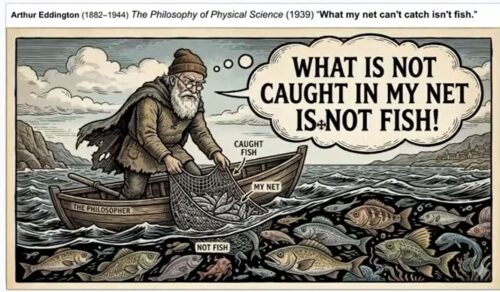
A popular quote in Arthur Eddington’s book the Philosophy of Physical Science (1939) is depicted in Figure 1 which shows a picture of a fisherman in a boat casting his net and a lot of fish in the sea. The fisherman knows that he can only catch some fish with his net and makes the bold statement: “Whatever I can’t catch is not fish”, which is not true. The rest of the fish that he cannot catch are also fish. But to justify his claim of the definition of fish is only those fish he can catch. The fisherman’s obvious bold claim represents the philosophical claim of the interpretations of the materialist scientists. All our human questions are never addressed like why do I exist? Where did we come from? Why does the universe exist? What’s the point of it all? Since material “causes” have no properties to be the source of existence of their “effects”, how do the effects come into existence? Such human questions are like all the fish outside of the fisherman’s net (representing the materialists’ definition of “legitimate questions” in Figure 1. But the materialists claim that if I can’t catch fish in my net, which means if I can’t answer a question in a lab, then it is not fish and thus not answerable. They claim that all these questions are not legitimate or true questions. Then, they continue their biased argument and claim that if a question is not legitimate then the answer will be also illegitimate. This means, according to them, these human questions are not logical i.e. illegitimate. It is not worthy of an answer. Therefore, boldly claim that like the fisherman’s example, they are not fish. Materialists usually reframe the questions being asked as something mystical, metaphysical, unscientific, meaningless. However as a human, it is perfectly reasonable to question and get a reasonable answer. I look for meaning in my life, in what I do. Can anyone be satisfied by doing something meaningless?
The mainstream materialist interpretations and AI tools operate the same way — like the fisherman, they can only work with what their net catches, and what falls outside empirical data is simply not addressed. We need to remind ourselves to be careful of the tricks played by the materialistic interpretations.