
Session 36 Notes
Aren’t we all looking to be happy right now and keep this happiness eternally? The Qur’an invites us to pay attention to the universe and witness the signs in creation. How are things in the universe coming into existence for me that I experience them? We discussed last time about reading the book of the universe in order to get to know its Author; see His qualities manifested in the universe. In a way, we all are studying the universe yet for different purposes. There is a stark difference in how the material scientists study the universe with a materialistic mindset and an interpretation confined only to what the eye sees. Some believers also fall into that category, and that is why the Qur’an encourages us to look beyond the physicality of what we observe by questioning: How can I explain the existence of what it is that I observe?
We must be careful with how we use our language to interpret creation as encouraged through the Quranic lens. Our language must challenge the materialistic interpretation of the universe which reduces creation to material, data oriented beings and physical existence only. How things come into being and into existence cannot be explained by giving a name, labels and providing data measurements. The human mind must question, (1) how does the thing being studied get its manifested qualities? (2) How does it know how to fit within the context of the whole universe? That is how the Qur’an guides us to study the universe, read the signs manifested in creation, which are not data only but are also qualities such as order, balance, harmony, design, art, etc. manifested to get to know our Creator better.
Let’s take an example (Picture 1) where a child is observing a bird singing from the branch of a tree in a park. The child is enjoying this wonderful creature displaying certain qualities, one of which is its singing, and the child declares: “Sweet little bird please stay and continue singing. I love your singing and I want to listen to it forever.”
Picture 1. Child interacting with a bird.
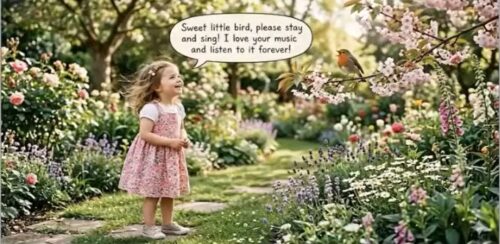
The materialists reduce the existence of the girl, her wonderment, her life, the existence of the bird, its life, its singing, to accidental adaptation of the environment, which is a reductionist approach. Can the girl’s genes adapt themselves to the environment? No. The wonderment, communication between the child and the bird, and the enjoyment of the song does not have anything to do with the material side of any being at all. The materialist approach reduces the human desire to experience the enjoyment of the bird’s song for eternity to blind matter. And yet, why does blind matter produce a creature with longing for eternity which blind matter cannot provide? Can this enjoyment be explained in the way materialists explain to be the result of “evolutionary necessity” which is shaped by cosmic accidents? Can it be the result of “random or natural genetic mutation”, “natural selection”, “adapting to the environment” as a result of the pressure of blind matter? Every claim made by materialists is appalling in the materialist world view but they speak as if they are really observing the qualities coming from matter itself, by itself. No one has shown in history that matter can create itself with the quality not to die. However, a believer is expected to honestly examine both the universe and his own existence with the qualities he has been endowed with, and through this examination he can arrive at a rational belief about the source of existence, acknowledging that such a source must be of a fundamentally different order of being than the universe itself, and that his understanding of the universe is necessarily mediated through the very capacities that source has equipped him with.
For the past three centuries, well-known philosophers have been propagating such materialist views to describe the reality of existence. Can a human being be that senseless and irrational to reject reality? The Qur’an thus uses severe language to warn people not to deny human reality which is not out of anger but out of mercy from the Lord of the universe. Divine love is heartbroken that we are denying the obvious reality manifested in front of our eyes. In a way God is begging to each one of us be careful not to contradict the reality that I can freely understand without being biased. The materialist scientists explain that their findings are based on scientific framework. However, as human beings reflecting on creation without any biases, we can see that the materialistic scientists are employing embellished and unrealistic terminologies.
Let’s take the invitation of the Qur’an seriously to observe the universe with an open mind and reflect on the following: why does the little child have to love the bird and enjoy its singing? I question the existence of this enjoyment, can it ever be explained away by “evolutionary necessity” which is based on random choices of blind material causation? Does this child need to love the bird and enjoy its singing to survive, otherwise she will become extinct in her existence? A little child who has barely begun to encounter the world, already loves the bird and longs for the pleasure it receives from the bird’s singing to last forever. The child has not learned this from the environment and thus the sense of pleasure is not acquired but is innate. This innate pleasure for eternity cannot be the product of blind matter adapting to the environment by itself. It is obvious to every human mind that this love must have been specially created in her feelings. That is why materialist scientists ultimately say that the universe is silent, doesn’t speak and carries no meaning at all – a conclusion that no child standing next to a singing bird could ever reach.
This idea of the universe being silent, not speaking, denying the meaning of creation is not merely a scientific hypothesis but is also supported by secularist philosophy like Nihilism, Absurdism, and Existentialism. The language in the Qur’an is that this idea “the universe is meaningless” will burn, not only in the Hereafter but in this world as well within themselves; they suffer with such understanding. This is precisely the burning the Qur’an describes – a suffocation of the spirit forced to live as though the very existence of the bird’s song means nothing. The spiritual side of beings is created for eternity whereas the body, material side is subject to decay and dies here in this world. Materialism sees only the body and calls it the whole human being; when the body loses its life they think human beings fall into nonexistence. Whereas the human experience, as well as what the Qur’anic message, calls neither one expendable but the spirit is what returns back to its Creator for an infinite life that it yearns. The solution offered by many secular philosophers is to just practically live your life and not bother about finding an answer to this, as they think that there is no answer. However, the Qur’an does provide the answer and warns those who do not see that every being in the universe is speaking with their own disposition. It says: “You certainly cannot make the dead hear. Nor can you make the deaf hear the call when they turn their backs and walk away. Nor can you lead the blind out of their misguidance…” (27:80-81 and 30:52-53). If they don’t want to hear as if blocking their ears and don’t want to see by closing their eyes, no one can make them hear and see that the bird is singing and announcing something meaningful, manifesting the power, wisdom, love of its Creator. This describes the physical feeling of materialist thinking.
Two ways of reading the same reality
When something happens in the universe – a star forms, life emerges, water flows downhill – both the material scientist and the believer are looking at the same event. However, they are fundamentally coming to different conclusions as to what they see.
The materialist says that this event is explained by causes, natural laws, forces, inherent qualities, structure, emergence, necessity – concepts that are supposed to belong entirely within the universe. The materialists claim that they explain the existence of everything within the physical existence of the universe. But, here is the problem: no one has ever seen a natural law or no one can show that the relationship between the two events are “necessarily” connected, or demonstrated that one thing “inherited” from the previously existing other thing. Inheritance has to be done consciously. There is no “causational” relationship. They are not observable physical objects.They don’t see that every moment of existence is a new creation having no relationship between each other, but automatically attach the previous moment of existence to the next moment of existence.
They are abstract and philosophically unexplained concepts the materialist uses to make sense of what they observe. The materialist owes an account of where these concepts come from and what makes them true. Or, are they imaginary concepts? That account has never been explained. They block the possibility that the things may be created by a one that is the Creator of the universe. They openly claim that there is no reasonable explanation within the universe other than attributing everything to an imaginary concept of “the chain of cause and effect,” a term they can never prove the existence of; it is nothing but a naming. They cannot prove that this concept really has an existence in the universe, simply because it is not true. They deliberately conflate the description of how the things exist and the explanation of their existence. They present their description of the reality of the things as if they are explaining how they themselves exist by themselves.
The believer understands that this can only be the work of an Absolute Being, not of the nature of this universe. I am experiencing this and come to a conclusion that nothing in this universe has the ability to give existence to anything (lailaha), therefore, there must be an Absolute Eternal Source of Existence, God (illallah). This conclusion is not about reciting a doctrine, rather as someone who is witnessing the universe and arriving at the conclusion through that witnessing, lailaha illallah is concluded. The verses of the Qur’an mention this but those verses need to be confirmed with the witnessing of the universe, they are not to be imitated. One of the fundamental Qur’anic principles is that one has to believe in this book. How do I believe in something without proof or evidence? The evidence is my experiential witnessing of the universe which I can confirm with the verses of the Qur’an. This is called the “belief in the book”, i.e. belief in Revelation, the speech of God.
Unfortunately, this is presented culturally in reverse such as: “because the Revelation says so, I believe in that”. We should be careful with the use of our language and how we present human conclusions to others without making it sound like bigotry. The witnessing of the universe humbly leads to genuine belief as opposed to imitated belief – it does not say “I possess the truth and you do not” or “you must believe because we say so”. It says, ‘come and observe honestly and see where it leads you.’ That is why religion is suffering from unrealistic presentations by many religious people including some bigoted leaders. One philosopher observes that “religion is like the opium of the people”. In other words when religion is presented as ‘believe because the Revelation says so’, when imitation replaces witnessing, and bigotry replaces invitation – the philosopher is not entirely wrong. But they confuse religion itself and how the religion is presented and politically manipulated and then they reach this conclusion. That version of religion is sedative, closes the human mind rather than opening it, and produces passive inheritance rather than active witnessing. The Qur’an does not offer opium, it does not hypnotize human beings but rather asks human beings to actively study, observe and witness the events in the universe and then come to a conclusion.
The believer says: I do not see self-explanatory matter. I see qualities like order, knowledge, coherence, functional complexity – that the material components themselves cannot account for as their own source. Just as ink and paper carry knowledge that did not originate from the ink and paper themselves, the physical event carries qualities that point to something beyond the physical event itself. I am not inventing this source – I am reading its traces in what is already there, the way that a reader encounters an author’s mind through marks on a page without needing the author to be physically present in the book. I am communicating with the knowledge of the author who must exist external to the book. This is the experienced reality and cannot be denied.
As a human being when I read a book I learn “knowledge” and that is another layer of existence that points to the existence of its source who must be conscious and knowledgeable being, and who must not be within the book. In order to write a book, the author must have an idea which should exist prior to the writing of the book. From our analogy of the book, we can say that the knowledge of the Creator of the universe must pre-exist before the creation of the universe. This is reasonable and must be accepted unless someone claims that “there is no knowledge we can learn from the book.” This was explained clearly in Muslim scholarship in the 8th to 9th centuries but we lost it in the following centuries starting from the 12th century where scholars started imitating religion with a few exceptions. As far as the formation of words and sentences is concerned, the materialists explain that over the course of time, for example, the letter “N” got close to the letter “O” and then the letter “W” to form a coherent meaningful word with the rest of the book. It is obvious that all these letters should know the whole book before making a meaningful word or sentence. They deny a subject they cannot answer in order to cover it up – and what they most urgently need to cover up is precisely what is most obvious. That is why they say that “there is no meaning in the existence of the universe”. Exactly! If the letters accidentally came into existence, the whole book should have no meaning. They put themselves in a meaningless existence by their own trap that they set to deny reality. They especially dare to deny the existence of non-physical realities like consciousness, intellect, and feelings of all living beings with no shame.
Here is the crucial difference in the burden of proof:
The materialists claim that everything in the universe needs to be empirically testable and that everything within it is accounted for by their concepts through which they explain the existence of the things. Since they claim that “the laws of physics” and “forces of nature” have a reality that can be relied upon in explaining why things happen in the way that they do. Thus, the materialists bear the burden of showing these concepts (“the laws of physics” or “the forces of nature”), that they genuinely exist and empirically testable, are self-sufficient and require nothing beyond themselves. No one can ever show the so-called “laws” experimentally in the physical existence of this universe. This burden of proof has not been met and impossible to be met because they are just concepts that the materialist minds made up. They accept that they cannot prove the existence of these “laws” in physical existence – yet they insist on describing the existence of the universe exclusively through the materialistic lens and use a language that is as if they are explaining them. This is bias in its precise definition. Materialists routinely accuse religious people of not being able to physically show the Creator of the universe when in fact they are the ones who are exhibiting this inability by committing to a framework built on laws, whose physical existence they cannot demonstrate, and continue using it anyway. This is nothing but stubbornness. Whereas, the believers who are sincerely observing the universe with a free mind conclude about the existence of an Absolute Creator.