
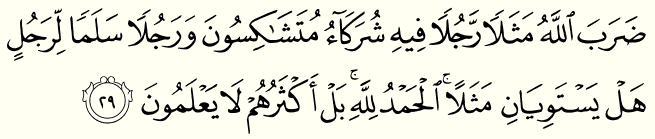
“God sets forth a parable: A man who has for his masters several partners, [all of them] at variance with one another, and a man depending wholly on one person: can these two be deemed equal as regards to their conditions? All praise is due to God [alone]: but most of them do not understand this.” Zumar (39):29
At first glance, this verse seems to be making a comparison between polytheism and monotheisms.
- Monotheism: a man with two masters.
- Polytheism: a man with multiple masters.
In order to feel confident in our belief, we need to reflect on the “reality of our existence”. Somehow, our reasoning always remains within this universe. We may just claim that the universe has been created by God but we may try to explain the things by attributing them to their immediate adjacent other beings. We may not be well trained to go beyond the regularity in the creation of the universe. We try to satisfy our hearts by borrowing religion, not completely denying it but we think that we have attained a satisfied heart by claiming that we believed in the religion and we are done. We are mostly deluded with the fact that what we follow is better than others because of our confidence level. We are expected to have some substantial evidence which will really convince us that what we follow is correct.
- ASK YOURSELF: Why does God tell me this (the above verse)? How can I have a satisfied heart from concluding the above verse?
Quran speaks at a simple level and expects its audience to respond according to their capacity i.e. we need to use our human qualities in order to expand it and confirm the message of the scripture. When we take the speech as the Creator speaking to us i.e. My Creator is speaking to me in order to guide me to teach me who I am in this world. We need to reflect on our existence first, only then we realize our purpose of existence.
Without establishing the proper base about the purpose of our existence within ourselves, we cannot follow a religion. Unfortunately, religion has been institutionalized by authorities as a means to impose anything on anyone. Example: if the clergymen say something, then everyone has to follow it. Similarly, if an “imam” declares that in our religion we believe in this or that, then, it must be so. In both cases, these authorities are presenting something based on his comprehension of the text. I must be convinced as well about the truthfulness of his conclusion.
When we read the Quran, we should read it in order to establish the foundations of our belief system. Around 5% of the Quran emphasizes on rituals, the rest mainly deals with how to establish our belief. Quran almost never gives us details on what to do practically. The Prophet (pbuh) presents the details of the message in human form. Since the Quran claims to be the Guiding Speech of the Creator of the human kind, we need to read it to train ourselves in belief matters within our own circumstances. Because the Quran was first revealed to the people who were accustomed with the Arabian culture, its understanding SHOULD NOT be confined within the context of that culture only. It speaks to each one of us within our own conditions “right now”.
- Example: The Prophet (pbuh) used to eat a lot of dates.
- There are two ways to understand this practice:
- We have to eat dates because it was the habit of the Prophet (pbuh).
- The Prophet lived in a climate where dates were the main produce of that climate and so we have to eat the produce of our climate.
#1 leads to imitation; #2 seems to be the purpose of the representation of a universal message: The Qur’an.
- We need to “universalize” the context of the revelation.
- All the Prophets spoke with parable so that the message is understood by everyone regardless of space-time.
The mission of the Prophet was to help people study the universe and observe a perfect order in the universe. For example: How do we explain the existence of a cat? Every cell and organ of the cat is dependent on an Absolute Being. We cannot attribute the existence of the cat to its organs only because it exists within the whole fabric of the universe including its animal senses. We need to incorporate monotheistic idea in our awareness of our existence and we need to get rid of polytheistic ideas which attribute the existence to its component parts and the sequences of accidental, purposeless happenings.
- Monotheistic idea: The universe has been created by an Absolute Being who consciously willed everything to be with His Wisdom/Knowledge/Power at an Absolute level.
- Polytheistic idea: Everything in this universe has a Divine quality in its own intrinsic nature.
- We need to work on confirming our belief, so that our hearts will be satisfied.
Question: How should we take the last part of the verse: “…most people do not understand”?
It means that most people do not think about how the things are coming into existence. The Quran encourages us to observe and investigate everything in creation, so we may gather our own evidence and thus come to our own conclusion. That is the only way human beings can establish “belief” within themselves. This last part is also a call for us to use our “human qualities” to connect every occurrence to an Absolute Being, so we do not fall into the polytheistic category. Otherwise our hearts will never attain satisfaction as a result of an artificial belief.
These types of verses show us that the Quran speaks to everyone in simple terms. Here is another verse to reflect on:
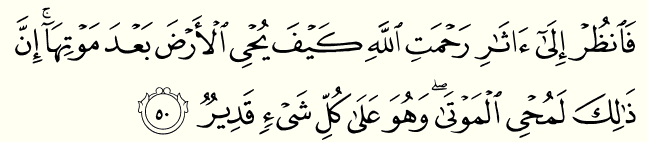
“Look then at the signs of Allah’ mercy, HOW He gives life to the earth after its death most surely He will raise the dead to life; and He has power over all things”. Rum (30):50
- What is God’s Mercy?
- The One who creates the universe (the Creator) is God and you have to see the traces of His Mercy in everything. Example: the plants, clouds, a snowflake, motion of particles, sunrise, and stars emitting light… just to name a few. These are some of the Mercy of the Creator that constitutes the “hidden” meanings in the creation (may remain “hidden” to those who do not reflect on beings.)
The Quran always encourages its reader to reflect on creation and see the Creator’s signs manifested in the universe. We should never reduce the purpose of the Quran as focusing on a certain group of people and labeling them, condemning some and praising the others. Nevertheless, we should try to understand the “concepts” of the different groups, so we can see the underlying cause that makes people practice a certain concept. We need to question everything. Example: What does it mean to not take the Christians as your friends? Clearly, it has to do with not taking in any idea which contradicts the Oneness and Absoluteness of God. In this regards, the scripture challenges the ideologies of the people in terms of their belief (theology).
- God’s Mercy means that everything comes into existence as a Mercy. Every particle is under the Will and command of its Creator in order to deliver the Mercy of its Creator.
- This implies that we cannot come with any idea that challenges the existence of Mercy in creation. One aspect of this Mercy is the way He gives life to the earth after its death: Nothing in the universe can give life (or, existence) to anything dead (or, nonexistent) but only the One who gives life to the universe; everything is given life (existence) by an Absolute Being.
We need to observe the universe and reflect on how He has been transforming us from different stages (babyadolescentadult). We are created with a strong desire to live young and happy forever in this universe. We do not consent to the fact that our life in this universe will come to an end. The new kind of creation (yom ul hashar) is the beginning of Eternal happiness. The real bliss starts after being resurrected from this universe. The Eternal life will be given forever because the One who gives us life here keeps his promise. How?

“…they will abide therein forever (in the new kind of creation).” Bayyinah (98):8
We never question that we will be given an “Eternal life”. The reason is simple: we do not see its signs in our existence right now. Example: observe how the Creator gives life to dead earth i.e. trees, plants… are dead in winter but the seeds are there as a sign of Eternity. From this, He is demonstrating to us that He will create us again as He promised us by giving us a strong desire of a happy existence forever, which is nothing but the requirements of His Mercy.
Our own existence is the proof of “Mercy” in this universe. This Merciful One promises us that He will give us an Eternal life. We have to be conscious about the reality of our existence.
- He creates us in an appropriate form with a new type of creation as He did when we were in the womb of our mother as a fetus. We died in that existence; and here we are in this universe, given a new type of existence. From there we were given appropriate equipment to carry our lives within the conditions of this universe. Now that we are in the “womb of the universe”, we need to expand our human senses (which we are equipped with) to connect our existence to an Eternal Source.
- This Eternal Source will be contradicting Himself if He gives us desires that cannot be met within the conditions of this universe and yet He shows us samples of it to experience here in this universe. Therefore, there must be another type of existence where those desires will be accomplished eternally. And He keeps His promise, so do not ignore this Eternal Source as He is your Lord taking care of you at every instance.
Any speech scaring us about the Resurrection day, as being the day of accountability is exploiting human weaknesses. We should not worry about being taken into account for our every sin/mistake. The worries usually arise when we lack the confidence in our existence because we do not trust our Lord. If our belief is strong, we are inclined to look for any available opportunity to thank our Maker and express our gratefulness to His Mercy.
Every generation has its own problems and will question accordingly. The next generation will be more liberal than the previous one. To address their concerns, we need to educate ourselves and establish a strong base of belief (imaan) within ourselves.
- Analogy: If a fruit tree is not bearing fruit, we have to get to the root of the tree to solve the problem.
- Similarly, we need to look at the root cause of any problem within our existence in this universe.
- Our main aim is to concentrate on the fundamentals of belief. Life is given to us to get to know the Source of our existence.